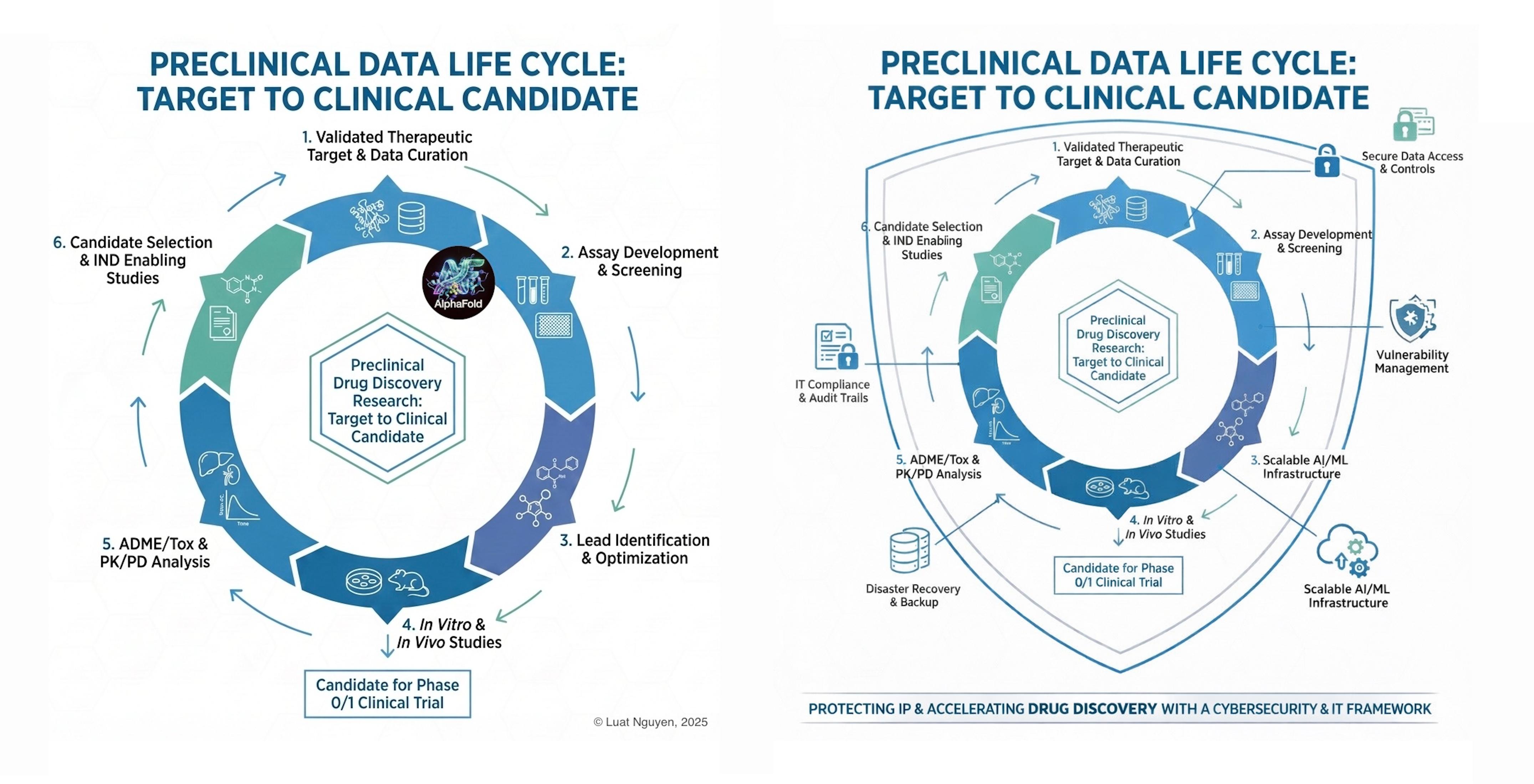
Here is a brief look at why AlphaFold is the engine driving this modern preclinical cycle.
1. Precision at the Starting Line (Target Validation)
The lifecycle begins with Validated Therapeutic Targets. Historically, determining the 3D structure of a protein required years of X-ray crystallography or cryo-electron microscopy. AlphaFold provides near-atomic accuracy in seconds, allowing researchers to visualize the “lock” (the protein) before they even begin designing the “key” (the drug).
2. Accelerating Assay Development & Screening
In Step 2, researchers develop assays to test how molecules interact with the target. With AlphaFold’s structural data, scientists can perform In Silico Screening. Instead of physically testing millions of random compounds, they can use computational models to predict which molecules are most likely to bind to specific pockets, drastically reducing the time and cost of early-stage screening.
3. Smarter Lead Optimization
During Lead Identification and Optimization (Step 3), AlphaFold allows for Structure-Based Drug Design. If a lead compound shows promise but has minor flaws, researchers can use the AI-generated model to see exactly where to add a functional group or shift an atom to improve binding affinity. This turns a “trial and error” process into a precise engineering task.
4. Predicting Downstream Success (ADME/Tox)
AlphaFold’s utility extends into Step 5: ADME/Tox and PK/PD analysis. By understanding how a drug might interact with non-target proteins (off-target effects), researchers can predict potential toxicity issues long before a candidate ever reaches a mouse model or a human patient.
The Bottom Line
AlphaFold isn’t just a tool; it is the connective tissue of the preclinical lifecycle. It bridges the gap between genomic data and physical chemistry, ensuring that the “Clinical Candidate” emerging at the end of the cycle is the most optimized, safe, and effective version possible.